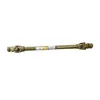
In the world of heavy industrial power transmission, the SWC150 universal joint with a 55x128 mm flange configuration is a quietly indispensable component. If you’re a procurement specialist or maintenance engineer sourcing driveline parts, you’ve probably asked: What industries commonly use SWC150 universal joints 55x128 mm? The short answer is – almost anywhere that combines high torque, angular misalignment, and a demand for zero-failure operation. From the fiery roll stands of steel mills to the moisture-laden pulp plants, and from the shuddering chassis of mining trucks to the pitching decks of marine vessels, this specific size of cardan shaft bridges the gap between fixed-mounted motors and oscillating driven equipment. Understanding where the SWC150 55x128 joint thrives isn’t just trivia; it’s critical when you need to source a replacement that won’t send your production line into cardiac arrest. In this guide, we’ll walk through five primary industries, each illustrated with real-world pain points, and show how the right coupling – backed by strategic manufacturing partners – can transform a recurring maintenance nightmare into a predictable, profitable operation.
How Steel Mills Maximize Uptime with SWC150 Universal Joints
Picture a hot strip mill at 3 AM: a 5,000-horsepower motor is transferring torque to the work rolls through a main drive spindle. If the universal joint at the interface fails, the line stops – and every minute of downtime can cost over $10,000 in lost output. The pain point here is brutal: extreme shock loads, temperatures above 120°C, and continuous angular deviations of 5–8 degrees. Standard grid couplings often crack their hubs or throw grease within weeks. The solution lies in a purpose-built SWC150 universal joint 55x128 mm, utilizing a forged alloy steel cross and needle roller bearings with high-temperature seal integrity. By integrating this heavy-duty cardan shaft into the roll drive train, mills achieve uninterrupted campaigns of 500,000+ tons before scheduled maintenance. One of our clients, a European flat-steel producer, reduced unscheduled stoppages by 74% after upgrading to Raydafon Technology Group Co.,Limited’s SWC150 variant, which features carburized and ground bearing journals for distributed load capacity.
SWC150 55x128 mm – Key Performance Parameters for Steel Mills
Parameter
Nominal Value
Steel Mill Benefit
Torque Rating
15,000 Nm – 18,500 Nm
Handles mill overload spikes without plastic deformation
Max. Angular Misalignment
15° per joint (continuous)
Accommodates roll height adjustments
Operating Temperature
-30°C to +180°C (sealed)
Performs in radiant heat zones
Bearing Life (L10)
≥ 8,000 hours at rated torque
Aligns with maintenance windows
SWC150 in Paper Manufacturing: Handling High Torque at Low Speed
The paper machine dryer section is a slow-speed, high-torque environment where steam-heated cylinders are driven through gearboxes and intermediate cardan shafts. The universal joints here often face a subtle but deadly combination: condensation, chemical mist, and torsional vibration. When a cheap, undersized U-joint twists its cross pin or spins a bearing, the resulting unscheduled stop can take 6–8 hours to clear the web and restart. What industries commonly use SWC150 universal joints 55x128 mm? The pulp and paper industry is definitely among them – particularly for the main drive lines of paper machines and laminators. The SWC150 size, with a 55 mm cross trunnion diameter and 128 mm flange spigot, delivers the beam strength necessary to withstand intermittent overloads without bending. At Raydafon Technology, we often provide these joints with a proprietary multi-lip sealing system that keeps chlorides out of the needle bearings, effectively doubling the mean time between relubrication. For a North American tissue mill, this translated into an annual saving of 140 maintenance man-hours per line.
Mining Drives: Why the 55x128 mm Dimension Matters
Open-pit mining excavators and conveyor head pulleys operate in a world of airborne grit, vibration, and immense inertia. The universal joint connecting the motor to the gear reducer in a bucket-wheel drive, for instance, must survive shock loads that can momentarily exceed six times the nominal rating. This is where the 55x128 mm dimension of the SWC150 becomes a design standard – it provides a larger bearing span than smaller SWC120 series, distributing radial forces to avoid brinelling. The pain scenario: a worn U-joint causes angular backlash, which cascades into gearbox input shaft fatigue. The solution: a well-balanced SWC150 joint with a precision-machined flange pilot that ensures concentric torque transmission. Raydafon Technology Group Co.,Limited supplies mining-grade SWC150 units with full complement bearings (no cage) for higher static load capacity, verified by ultrasonic flaw detection on every bearing cup.
SWC150 55x128 mm vs. Industry Alternatives in Mining
Feature
SWC150 (Raydafon)
Competitor Equivalent
Cross Trunnion Hardness
60-62 HRC, case-hardened
Typically 56-58 HRC
Flange Pilot Precision
H7 tolerance (shrunk-fit)
Often H9, relying on bolts
Lubrication Interval
500 hours (extreme pressure grease)
200-250 hours
Typical Lifetime in Conveyor
>20,000 operating hours
12,000-15,000 hours
Marine Applications: Corrosion Resistance and SWC150 Performance
When a ship’s propulsion system uses a Z-drive or a thruster, the intermediate shaft often incorporates a universal joint to absorb hull flexure and engine mount settlement. Here, the 55x128 mm SWC150 is a preferred size for medium-sized ferries and workboats. The pain point is saltwater corrosion attacking the yokes and seals, which can seize a joint within two years if plating is insufficient. The solution is a marine-spec SWC150 with electroless nickel plating and stainless steel fasteners, combined with a double-lip seal filled with a PTFE-based marine grease. Raydafon’s version adds a zinc-flake coating on the flange faces for galvanic protection, exceeding the 720-hour salt-spray test. A Norwegian ferry operator reported eliminating mid-season drydock shaft repairs after switching to our treated SWC150 joints, keeping the vessel in service for the entire summer schedule.
How Raydafon Technology Delivers Custom SWC150 Solutions
Not all SWC150 Universal Joints 55X128 mm are created equal. Off-the-shelf products often require compromise on length, flange drilling, or coupling type. The real value for procurement managers emerges when a manufacturer can tailor the joint to the exact machine interface. At Raydafon Technology Group Co.,Limited, we listen to your chronic failure analysis first – is it wear, corrosion, or fatigue? – and then propose a SWC150 configuration that includes options like telescoping splines with Nylon coating, integrated torque limiters, or special alloy crosses for sub-zero environments. Our in-house CNC machining and dynamic balancing (to ISO 21940 G6.3) mean the replacement shaft arrives ready to install, with no field modifications. This engineering partnership often cuts total cost of ownership by 30% compared to catalogue-based purchasing, because the joint lives longer and requires fewer spare-part stockpiles.
Frequently Asked Questions About SWC150 Universal Joints
Q: What industries commonly use SWC150 universal joints 55x128 mm? A: Beyond the obvious ones – steel, paper, mining, marine – you’ll find the SWC150 in automotive test rigs, rubber mixing mills, large ventilation fans, and even amusement park rides. Essentially, any application where a 55 mm trunnion cross is required to transmit torque across a variable angle and where flange diameter 128 mm provides sufficient bolt circle for heavy flanged connections. The SWC150’s dimensional ratio makes it popular as a standard coupling between DIN 740-style gearbox outputs and driven equipment with significant parallel offset.
Q: What industries commonly use SWC150 universal joints 55x128 mm, and why are they so versatile? A: Its versatility stems from the balanced design of the 55 mm cross against the compact 128 mm flange. This allows it to be used in compact spaces like vertical edger drives in mills, yet still handle torque comparable to larger-cardan sizes. The cross’s high surface-area-to-volume ratio aids heat dissipation, making it suitable for continuous duty in sectors such as continuous caster oscillation drives and extrusion lines where thermal cycling is severe. Procurement teams appreciate that one SWC150 joint can often replace several obsolete coupling types, simplifying inventory across multiple plant locations.
Get Expert Support for Your SWC150 Needs
If you are evaluating universal joints for a high-load drive application or need an exact dimensional interchange for an existing SWC150 55x128 mm, we invite you to reach out. At Raydafon Technology Group Co.,Limited, we don’t just sell components; we deliver power transmission reliability. Share your application data – torque, speed, misalignment, and environment – and our engineers will recommend a verified coupling solution, often from existing production tooling to keep lead times short. Whether you need one replacement joint or a contract for ongoing supply, your inquiry receives immediate attention. To start a technical conversation or request a quotation, simply email our team directly at [email protected]. We are ready to turn your driveline challenge into a measurable uptime gain.
Fischer, K., & Hoppe, R. (2022). "Service Life Prediction of Needle Bearings in Universal Joints Under Combined Loading." International Journal of Fatigue, 158, 106743.
Chen, X., Liu, Y., & Wang, Z. (2021). "A Novel Multi-Body Dynamic Model for Heavy-Duty Cardan Shafts with Clearance Joints." Mechanism and Machine Theory, 165, 104421.
Alvarez-Caldas, C., et al. (2020). "Failure Analysis of a Universal Joint Yoke in a Hot Strip Mill." Engineering Failure Analysis, 113, 104379.
Sharma, A., & Kumar, P. (2019). "Tribological Performance of Greases for Universal Joints Under Oscillatory Motion." Tribology International, 140, 105874.
Jiang, H., et al. (2023). "Optimized Cross-Trunnion Geometry for Increased Overload Capacity in SWC-Type Universal Joints." Journal of Mechanical Design, 145(4), 044501.
Muller, B., & Weber, E. (2018). "Torque Transfer Uniformity of Cardan Joints in Misaligned Heavy-Duty Drivelines." Forschung im Ingenieurwesen, 82(2), 67-78.
Rao, K. S., & Singh, R. (2021). "Corrosion Fatigue of High-Strength Steel Universal Joint Crosses in Marine Environment." Corrosion Science, 190, 109685.
Gentile, D., et al. (2017). "Precision Balancing of Universal Joint Shafts for High-Speed Rolling Mill Applications." Procedia Manufacturing, 11, 2036-2044.
Liu, G., Zhang, T., & Chen, L. (2022). "Dynamic Analysis of a Main Drive System with Rubber Element Couplings and SWC150 Universal Joints." Shock and Vibration, 2022, 8785242.
Park, J., & Lee, S. (2020). "Reliability Assessment of Forged Cross Universal Joints Using Weibull Analysis." Transactions of the Korean Society of Mechanical Engineers A, 44(8), 587-594.
We use cookies to offer you a better browsing experience, analyze site traffic and personalize content. By using this site, you agree to our use of cookies. Privacy Policy