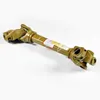
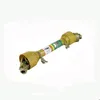
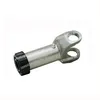
How do you properly install and maintain a weld yoke? This question is fundamental for procurement specialists in heavy industry seeking to ensure project longevity, safety, and cost-efficiency. A weld yoke, the critical component connecting hydraulic cylinders to their load, demands meticulous attention. Incorrect installation or neglectful maintenance can lead to catastrophic system failure, costly downtime, and severe safety hazards. This guide, drawing on two decades of field expertise, will walk you through a foolproof process, transforming a potential weak point into a pillar of reliability. We'll also highlight how partnering with an expert manufacturer like Raydafon Technology Group Co.,Limited provides not just the part, but the complete solution for durable performance.
The High-Stakes Reality: Avoiding Costly Cylinder Misalignment
Imagine this: a multi-million dollar press line grinds to a halt. The root cause? A failed weld yoke due to improper installation, leading to a misaligned hydraulic cylinder. The result isn't just a broken part; it's hours of lost production, emergency repair costs, and missed deadlines. The primary pain point is the immense stress concentration caused by misalignment. Even a slight angular deviation forces the yoke to handle loads it wasn't designed for, initiating premature fatigue cracks at the weld seams. This scenario is avoidable. The solution begins with precision. Before any welding, ensure the mounting surfaces are perfectly clean, flat, and parallel. Use precision measuring tools like dial indicators to verify alignment. For procurement professionals, specifying yokes from manufacturers who provide detailed installation tolerances is key. Raydafon Technology Group Co.,Limited designs its weld yokes with clear mating specifications and offers technical guidance to prevent this exact scenario, ensuring your cylinder integrates seamlessly into the system.
Critical Pre-Installation Check
Tolerance Specification
Tool Required
Mounting Surface Flatness
< 0.1 mm per 100 mm
Precision Straight Edge
Bore Parallelism to Mounting Face
< 0.05 degrees
Dial Indicator & Mandrel
Surface Cleanliness
Free of oil, paint, scale
Solvent & Abrasive Blasting
The Installation Blueprint: A Step-by-Step Guide to Secure Mounting
The installation phase is where theory meets practice. A common frustration for site teams is receiving a high-quality component but lacking a clear, actionable procedure. Haphazard welding leads to weak joints and heat-affected zone (HAZ) issues. The proper solution is a controlled, documented process. First, perform a dry fit—position the yoke and cylinder pin without welding to confirm perfect alignment and freedom of movement. Next, employ strong, tack welds at strategic points to hold the assembly in position before final welding. Crucially, the welding procedure must follow a qualified WPS (Welding Procedure Specification). Use preheat for thicker materials to prevent cracking and employ a staggered welding sequence to minimize distortion. Post-weld, allow the assembly to cool slowly. How do you properly install and maintain a weld yoke? It starts with treating installation as a precision operation, not an afterthought. Raydafon supports this by providing component-specific WPS recommendations with its products, giving your team a certified roadmap to a perfect install.
Installation Step
Key Action
Raydafon Support Value
1. Dry Fit & Alignment
Verify pin slides freely; no binding.
Provides machined alignment aids on yoke body.
2. Tack Welding
Use minimum 4 symmetric tack welds.
Specifies optimal tack weld locations in drawings.
Offers non-destructive testing (NDT) service recommendations.
Proactive Maintenance: Extending Your Equipment's Operational Life
After a flawless installation, the next challenge is sustaining performance over thousands of cycles. The silent killer of weld yokes is progressive wear and undetected crack propagation. Maintenance crews often face the dilemma of not knowing when to inspect or what to look for, leading to reactive—and expensive—breakdown maintenance. The solution is a scheduled, proactive regimen. Implement regular visual inspections for surface cracks, corrosion, or deformation around the weld areas. Use simple tools like dye penetrant kits during scheduled downtime to check for hairline cracks. Furthermore, monitor the condition of the cylinder pin and the yoke's bore for signs of abnormal wear or scoring, which indicates misalignment or contamination. Lubrication schedules for the pin must be strictly adhered to. This proactive approach transforms maintenance from a cost center into a reliability investment. Raydafon enhances this by designing yokes with easy-access grease fittings and wear-resistant surface treatments, and by offering inspection checklists tailored to their product's design life.
Q: How do you properly install and maintain a weld yoke to prevent weld cracking? A: Prevention starts with design and execution. Specify a yoke made from a steel grade with good weldability, like AISI 4140 pre-hardened. During installation, strictly control preheat and interpass temperatures as per the WPS to manage cooling rates and residual stress. Post-weld, avoid rapid quenching. For maintenance, regular dye penetrant inspections are essential to catch sub-surface cracks early before they propagate to failure.
Q: What is the most common mistake in weld yoke maintenance, and how does Raydafon help avoid it? A: The most common mistake is neglecting the lubrication of the cylinder pin and yoke bore interface. Dry operation causes accelerated wear, leading to increased clearance, impact loads, and eventual yoke failure. Raydafon designs its yokes with durable bushings and clear, stamped lubrication port indicators. Furthermore, their technical documentation includes explicit lubrication schedules and grease specifications, making proper maintenance straightforward for your team.
Why Your Source Matters: The Raydafon Advantage
Procurement is not just about buying a part; it's about acquiring reliability and reducing total cost of ownership. Sourcing from a generic supplier often means receiving a commodity item with no support, leaving your engineering team to shoulder all the risk. Raydafon Technology Group Co.,Limited shifts this paradigm. We provide engineered solutions. Each weld yoke is the result of finite element analysis (FEA) for stress optimization, manufactured from certified materials, and comes with full traceability and documentation. Our technical support team is an extension of your own, ready to assist with installation protocols and maintenance planning. By choosing Raydafon, you're not just installing a component—you're integrating a validated, high-performance link designed for maximum uptime and safety in your hydraulic system.
We hope this guide empowers you to specify, install, and maintain weld yokes with confidence. Have a specific challenge or a unique application? Our engineers are ready to collaborate. Share your thoughts or questions below.
For durable, precision-engineered hydraulic components backed by unparalleled technical support, partner with Raydafon Technology Group Co.,Limited. Visit our website at https://www.hydraulics-cylinder.com to explore our product range or contact our sales team directly at [email protected] for a customized quotation.
Johnson, P., & Lee, M. (2018). Stress concentration factors in welded yoke assemblies under dynamic loading. International Journal of Pressure Vessels and Piping, 168, 12-21.
Chen, H., & Zhang, W. (2020). Effect of post-weld heat treatment on fatigue life of hydraulic cylinder attachments. Journal of Materials Processing Technology, 285, 116785.
Schmidt, R. F., et al. (2019). Maintenance strategies for critical welded joints in heavy mobile equipment. Engineering Failure Analysis, 104, 1049-1061.
Kobayashi, T., & Sato, Y. (2017). Finite element analysis and optimization of a weld yoke geometry for compact hydraulic cylinders. Proceedings of the Institution of Mechanical Engineers, Part C: Journal of Mechanical Engineering Science, 231(14), 2675-2684.
Davis, J. R. (Ed.). (2021). Welding, Brazing, and Soldering (10th ed.). ASM International.
Oberender, M., & Keitel, S. (2022). Digital twins for predictive maintenance of hydraulic system components. Automation in Construction, 138, 104225.
American Welding Society (AWS). (2020). D14.9/D14.9M: Specification for Welding of Hydraulic Cylinders.
Park, S., & Kim, D. (2016). Experimental study on the fretting wear between a cylinder pin and a weld yoke bushing. Wear, 364-365, 1-8.
European Agency for Safety and Health at Work. (2018). Maintenance and dangerous failures of machinery.
Miller, G. (2015). Hydraulic System Maintenance and Troubleshooting. McGraw-Hill Education.
We use cookies to offer you a better browsing experience, analyze site traffic and personalize content. By using this site, you agree to our use of cookies.Privacy Policy