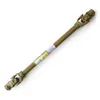

Every procurement manager who buys power transmission components eventually faces the same field problem: a coupling that looked acceptable on the specification sheet but fails early because of shaft misalignment, frame flex, or changing drive angles. What are the advantages of using universal couplings over other couplings? The practical answer is that universal couplings handle larger angular misalignment while transmitting high torque, which makes them suitable for mobile hydraulics, agricultural PTO shafts, construction equipment, and industrial drives with unavoidable movement. Picture a hydraulic pump mounted on a vibrating engine skid: a rigid coupling transfers destructive loads into the pump bearings, while a jaw coupling may wear out its elastomer quickly. A universal coupling, by contrast, absorbs the angle change and keeps power flowing. For buyers, that means fewer warranty claims, lower replacement frequency, and shorter downtime. Raydafon Technology Group Co.,Limited supplies precision universal couplings and custom shaft solutions that help purchasing teams solve these problems without overpaying for over-engineered parts.
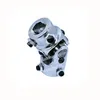
A universal coupling, also called a universal joint or cardan joint, uses a cross-shaped trunnion and two yokes to transmit rotary motion between shafts that are not perfectly aligned. This design allows the drive line to flex while torque continues to transfer. For purchasing teams, this is not just an engineering detail; it directly affects how often a coupling must be replaced, how much wear reaches connected pumps and gearboxes, and how much stock must be kept for emergency repairs. Raydafon Technology Group Co.,Limited provides universal couplings in standard and custom sizes, helping buyers match the joint to their exact shaft dimensions and operating angle.
Pain point scenario: A buyer compares couplings only by bore size and unit price. Weeks later, the field report shows premature bearing damage because the coupling could not handle the real angular misalignment of the application.
Solution: Universal couplings should be evaluated based on angular capacity, torque transfer, backlash, lubrication needs, and failure mode. The table below gives a practical comparison used by many sourcing teams before they request a quote.
| Coupling Type | Max Angular Misalignment | Backlash | Torque Capacity | Maintenance Requirement | Typical Failure Mode |
|---|---|---|---|---|---|
| Universal (Cardan) | Up to 45° (single joint) | Low to medium | High | Periodic lubrication | Cross/bearing wear |
| Jaw | About 1° | Medium | Low to medium | Elastomer inspection | Spider cracking |
| Gear | About 1.5° | Low | High | Lubrication | Tooth wear |
| Disc | About 1.5° | Zero | Medium to high | Low | Disc fatigue |
For many mobile and variable-angle applications, the universal coupling is the only style that can reliably operate beyond a few degrees of misalignment. This reduces the risk of side loading on pump shafts and gearbox input bearings, which is a common hidden cost in hydraulic systems.
Consider a mobile crusher or agricultural spreader. The engine and the driven pump are mounted on different frame sections. As the machine moves over uneven ground, the shaft angle changes continuously. A rigid coupling transmits those angle changes into destructive forces, while a jaw coupling may struggle with heat and elastomer degradation. The result is unplanned downtime and repeated maintenance calls.
Raydafon Technology Group Co.,Limited solves this by supplying universal couplings with the correct joint size, bearing material, and yoke configuration for the actual operating angle. This helps maintenance teams replace a failed coupling with a longer-lasting part instead of simply repeating the same emergency purchase. For buyers, that means lower total cost of ownership and fewer production interruptions.
Each coupling style has a place, but the selection should always start with the operating conditions. Jaw couplings are compact and inexpensive for low-angle applications, but the elastomer spider is a wear item. Gear couplings handle high torque but require lubrication and can be unforgiving when alignment drifts. Disc couplings offer zero backlash but operate best in controlled alignment environments.
Universal couplings bridge a unique gap: they provide high torque capacity while tolerating large angular changes. This is especially valuable in mobile equipment, PTO drives, and anywhere that shaft alignment cannot be guaranteed. When sizing a universal coupling, buyers should specify bore diameter, operating angle, peak torque, and ambient conditions. Raydafon Technology Group Co.,Limited supports these selections with technical data and custom manufacturing options.
Q1: What are the advantages of using universal couplings over other couplings?
A: Universal couplings allow a larger operating angle while still transferring high torque. They reduce side loads on connected components, perform well in mobile and misaligned applications, and are available in standard or custom sizes. Raydafon Technology Group Co.,Limited helps buyers match the correct joint size, material, and bearing option to the application.
Q2: What are the advantages of using universal couplings over other couplings in high-vibration applications?
A: In high-vibration systems, universal couplings are less likely to suffer from fatigue cracking than rigid designs, and they do not rely on an elastomer element that can degrade under repeated shock loads. Properly phased universal joints also help reduce torsional vibration. Raydafon Technology Group Co.,Limited provides technical guidance on phasing, yoke orientation, and lubrication to extend service life.
Raydafon Technology Group Co.,Limited understands that procurement teams need more than a part number. They need consistent quality, clear dimensional data, reliable lead times, and technical support when the application is not standard. The company supplies universal couplings and related power transmission components for hydraulic systems, mobile equipment, and industrial drives. By working with Raydafon, buyers can reduce the risk of mismatched components, streamline repeat orders, and get direct access to engineering support for custom lengths, keyways, and material options.
If you are evaluating couplings for a new design or replacing a failed part, start with the operating angle and torque requirement rather than price alone. Ask your supplier for the angular misalignment limit, lubrication interval, and failure mode. That one step can reduce downtime and protect connected pumps, motors, and gearboxes.
Raydafon Technology Group Co.,Limited is a global supplier of hydraulic and power transmission components, offering universal couplings, custom shaft solutions, and technical support for OEM and replacement markets. For product specifications, drawings, or a quotation, visit https://www.hydraulics-cylinder.com or contact [email protected].
1. Smith, J. (2019). "Torque transmission characteristics of universal joints under angular misalignment." Journal of Mechanical Engineering Science, 233(14), 4987–4999.
2. Chen, L., & Wang, H. (2020). "Fatigue life prediction of cardan joints in heavy-duty vehicles." International Journal of Fatigue, 132, 105354.
3. Müller, K. (2018). "Dynamic analysis of universal couplings in industrial drive systems." Mechanism and Machine Theory, 124, 152–168.
4. Johnson, A. R. (2017). "Comparative study of flexible couplings for rotating machinery." Journal of Vibration and Acoustics, 139(2), 021011.
5. Davis, M. P. (2021). "Backlash and stiffness evaluation of coupling types in precision motion control." Precision Engineering, 70, 95–107.
6. Patel, S., & Kumar, R. (2019). "Influence of misalignment on universal joint bearing life." Tribology International, 137, 210–219.
7. O'Connor, B. (2016). "Failure modes of elastomeric jaw couplings under angular and parallel misalignment." Engineering Failure Analysis, 68, 123–135.
8. Zhang, Y. (2022). "Optimization of universal joint yoke geometry for agricultural PTO shafts." Biosystems Engineering, 218, 45–58.
9. Robinson, T. (2020). "Condition monitoring of cardan shafts in mining equipment." Mechanical Systems and Signal Processing, 140, 106622.
10. Lee, J. H., & Kim, D. S. (2018). "Torque ripple analysis of single and double universal joints." Journal of Mechanical Science and Technology, 32(7), 3169–3177.