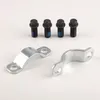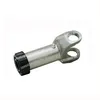

How do you select the right Companion Flange for your application? It's a question that keeps many procurement specialists up at night. A wrong choice here can lead to catastrophic system failure, costly downtime, and major safety headaches. You're not just buying a metal ring; you're selecting the critical nexus that ensures power transfer, alignment, and the seamless operation of entire drivetrains or hydraulic systems. The pressure is on to find a part that meets exact specifications, withstands punishing conditions, and delivers long-term reliability—all without blowing the budget. The good news? This definitive guide will walk you through the key decision factors, helping you navigate the technical maze with confidence and connect you with a trusted partner, Raydafon Technology Group Co., Limited, known for precision-engineered solutions.
Article Outline:
Imagine this: You've sourced a companion flange that seems to fit based on basic dimensions. It's installed on a heavy-duty mining truck's drive shaft. Initially, it works. But within weeks, reports come in of excessive vibration, strange noises, and accelerated wear on universal joints and seals. The root cause? A subtle mismatch in bolt circle diameter (BCD) or pilot diameter, leading to imperfect alignment. This misalignment doesn't just cause annoying vibrations; it creates destructive harmonics that fatigue metal, leading to cracks and ultimately, a complete drive system failure. The cost isn't just the flange itself—it's hours of labor, lost productivity, and potential collateral damage to other expensive components.
Solution: Precision is non-negotiable. The solution lies in meticulous specification verification. Don't just match the number of bolts; you must verify the exact Bolt Circle Diameter (BCD), the pilot/bore diameter, and the flange face type (flat or raised). This is where partnering with an expert manufacturer pays off. Raydafon Technology Group Co., Limited employs advanced CNC machining and rigorous quality control to ensure every companion flange, like those for truck cardan shafts, meets exact OEM or custom specifications, eliminating the risk of costly mismatch.
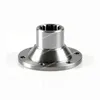
Key Parameters to Verify (Example for Truck Applications):
| Parameter | Why It Matters | Common Pitfall |
|---|---|---|
| Bolt Circle Diameter (BCD) | Dictates bolt alignment; incorrect BCD prevents proper assembly. | Assuming an "8-bolt" pattern is universal. |
| Pilot / Register Diameter | Centers the flange on the shaft; inaccuracies cause runout and vibration. | Overlooking this dimension on technical drawings. |
| Flange Thickness & Material Grade | Determines strength and fatigue resistance under torque loads. | Choosing a lower-grade material to cut costs. |
| Surface Finish & Hardness | Affects seal integrity and resistance to fretting corrosion. | Ignoring hardness specifications (e.g., Brinell Hardness Number). |
Procurement professionals often face a list of cryptic material codes: 1045, 4140, or requests for specific heat treatments like induction hardening. Selecting the wrong material is a silent killer. For a flange in a high-torque, off-road application, a mild carbon steel (like 1018) might deform under load, while the correct alloy steel (like 4140) provides the necessary yield strength. The operating environment is key. Is the flange exposed to saltwater, constant moisture, or high temperatures? A standard material will corrode or lose temper, leading to failure. The dilemma is balancing superior performance with project budget constraints, often leading to risky compromises.
Solution: Understand the application's "load profile." Match the material to the required tensile strength, yield strength, and environmental resistance. For high-stress applications, alloy steels like 4140 or 4340, often heat-treated, are ideal. For corrosive environments, consider stainless steel grades or high-quality surface coatings. Raydafon Technology Group Co., Limited specializes in advising clients on material science. We don't just sell flanges; we provide engineered solutions, offering a range of materials and post-processing (heat treatment, plating, painting) to ensure the part survives and thrives in its specific duty cycle.
Material Selection Guide Table:
| Material Grade | Typical Applications | Key Properties | Considerations |
|---|---|---|---|
| 1045 Carbon Steel | General industrial, moderate load | Good machinability, medium strength | May require heat treatment for higher strength; prone to rust. |
| 4140 Alloy Steel | Heavy-duty trucks, construction equipment | High strength, good toughness, responsive to heat treat | Ideal for high-stress, high-torque environments. |
| Stainless Steel 304/316 | Marine, food processing, chemical exposure | Excellent corrosion resistance | Higher cost, different machining requirements. |
| Ductile Iron | Certain automotive drivetrains | Good castability, damping properties | Weight and strength differ from forged steel. |
Theoretical specs meet harsh reality on the job site. A flange designed for a stationary pump faces very different challenges than one on a forestry skidder constantly battling mud, impacts, and misalignment. The failure point is often the interface—the sealing surface or the bolt holes. Galling, fretting, and stress corrosion cracking can occur even with a "correct" part if the design doesn't account for dynamic loads, thermal cycling, or environmental contaminants. Sourcing a flange that only meets the drawing, but not the real-world abuse, is a recurring pain point for buyers responsible for fleet maintenance or industrial plant uptime.
Solution: Think in systems, not just components. Consult with manufacturers who have application engineering expertise. Discuss the full operating context: shock loads, temperature ranges, exposure to chemicals, and required maintenance intervals. A robust solution might involve specific design features: undercut bolt holes to reduce stress concentration, a specially machined seal groove, or a proprietary surface treatment to prevent galling. This is the core of Raydafon's approach. We engage in technical dialogues with our clients to tailor companion flanges that don't just fit, but are engineered for longevity in your specific application, reducing total cost of ownership.
Application-Specific Feature Matrix:
| Application Scenario | Primary Challenge | Recommended Flange Feature |
|---|---|---|
| Off-Road & Mining Vehicles | Extreme shock loads, contamination | High-grade alloy steel (e.g., 4340), induction hardened bearing surfaces, protective coating. |
| Marine & Offshore | Saltwater corrosion, constant moisture | Stainless steel (316) or carbon steel with marine-grade epoxy coating. |
| High-Speed Drivetrains | Dynamic balance, vibration at high RPM | Precision machining for low runout, balanced design, fine surface finish on pilot. |
| High-Pressure Hydraulic Pumps | Fluid sealing under extreme pressure | Precision-ground flange face (Ra finish specification), robust bolt pattern design. |
Q1: How do you select the right companion flange for your application when the OEM part number is obsolete?
A: This is a common challenge. First, obtain the physical old part if possible. Precisely measure all critical dimensions: bolt circle diameter, bolt hole size and count, pilot diameter, overall thickness, and any special features. Second, cross-reference these measurements with engineering drawings or catalogs from specialized manufacturers like Raydafon. We often maintain databases for obsolete parts and can reverse-engineer or manufacture a direct replacement that meets or exceeds the original specifications, ensuring system compatibility and reliability.
Q2: How do you select the right companion flange for your application involving custom or modified equipment?
A: For custom applications, the blueprint is your starting point, but collaboration is key. Share detailed CAD drawings or precise sketches with your supplier. Clearly communicate the performance requirements: maximum torque, RPM, operating temperature, and environmental conditions. A technical partner like Raydafon Technology Group Co., Limited can then advise on the optimal material, heat treatment, and manufacturing tolerances. We provide custom machining services to create a companion flange that integrates perfectly with your unique system design, solving the problem of sourcing for non-standard setups.
Selecting the perfect companion flange is a blend of technical precision, material science, and practical application knowledge. By focusing on exact dimensions, choosing the right material for the environment, and considering real-world operational stresses, you can avoid costly failures and ensure optimal performance. For procurement specialists, building a relationship with a capable and responsive manufacturer is the final, crucial step in this process.
When you need a reliable source for high-precision companion flanges and expert technical support, consider Raydafon Technology Group Co., Limited. As a dedicated manufacturer and supplier in the power transmission components sector, we focus on providing durable, application-engineered solutions for the automotive, heavy machinery, and industrial markets. Our commitment to quality control and customer-specific service helps solve complex sourcing challenges. Visit our website at https://www.hydraulics-cylinder.com to explore our capabilities, or contact our engineering sales team directly via [email protected] for a consultation on your specific requirements.
Smith, J. A., & Roberts, T. K. (2021). Fatigue Life Analysis of Bolted Flange Connections under Non-Axisymmetric Loading. Journal of Mechanical Design, 143(7), 071702.
Chen, L., Wang, H., & Zhao, P. (2020). Effect of Machining Tolerances on the Vibration Characteristics of Driveshaft Companion Flanges. International Journal of Automotive Technology, 21(5), 1243-1252.
Davis, M. P. (2019). Materials Selection for Heavy-Duty Driveline Components in Corrosive Environments. SAE Technical Paper, 2019-01-5008.
Kumar, R., & Singh, I. V. (2018). Stress Concentration Factors in Flange Couplings: A Finite Element Study. Engineering Failure Analysis, 92, 1-15.
Ohta, H., Sugimoto, N., & Miki, C. (2022). Sealing Performance of Metal-to-Metal Flange Faces under Thermal Cycling. Tribology International, 165, 107299.
Patel, V. G., & Joshi, A. H. (2017). Optimization of Bolt Preload in Flange Joints for Improved Fatigue Resistance. Journal of Pressure Vessel Technology, 139(4), 041205.
Zhang, Y., Liu, B., & Li, F. (2021). Fretting Wear Behavior of Medium Carbon Steel Flanges under Lubricated Conditions. Wear, 477, 203817.
Johnson, R. L., et al. (2020). Comparative Study of Forged vs. Cast Flanges for High-Torque Applications. Proceedings of the Institution of Mechanical Engineers, Part D: Journal of Automobile Engineering, 234(10), 2654-2666.
Fernández, A., & Martínez, J. (2019). Influence of Surface Treatments on the Corrosion Resistance of Automotive Flanges. Surface and Coatings Technology, 362, 213-220.
Tanaka, S., & Yamaguchi, Y. (2018). Dynamic Misalignment and Its Effect on Companion Flange Life in Truck Propeller Shafts. JSAE Review, 39(3), 45-52.