
What causes brake pads to wear out quickly? For procurement professionals navigating the global aftermarket, this isn't just a technical question—it's a constant operational headache impacting costs, supply chain reliability, and end-customer satisfaction. Rapid wear leads to frequent replacements, increased inventory pressure, and potential liability issues from subpar performance. The root causes are often a complex interplay of driving habits, environmental conditions, and, critically, the quality and composition of the Brake pad material itself. Understanding these factors is the first step toward sourcing more durable, cost-effective solutions that keep vehicles safer and supply chains smoother.
Imagine a fleet manager reviewing maintenance logs, noticing a pattern of premature brake pad replacements across city-based delivery vans. The scenario is all too common. Aggressive driving habits like hard braking and rapid acceleration generate intense heat and friction, literally grinding the pad material away at an accelerated rate. Similarly, constant stop-and-go traffic in urban environments doesn't allow brakes to cool adequately, leading to overheating and glazing, which reduces effectiveness and increases wear. For procurement officers, this translates into unpredictable part consumption and difficulty in forecasting demand.
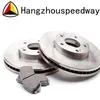
The solution lies in specifying brake pads engineered for high-temperature stability and consistent performance under stress. This is where material science makes the difference. Raydafon Technology Group Co.,Limited addresses this precise challenge by utilizing advanced semi-metallic and ceramic formulations in products like our OEM-Brake-Pad-for-Lexus-Mitsubish-Toyota series. These materials maintain their structural integrity and frictional properties even under the thermal duress of demanding driving cycles, leading to longer service life and more predictable replacement intervals for your clients.
Key parameters to evaluate when sourcing for such conditions:
| Parameter | Importance for Durability | Raydafon's Typical Spec |
|---|---|---|
| Friction Coefficient (μ) | Stable performance across temperatures prevents fade and uneven wear. | 0.38 - 0.42 (EE rated) |
| Compressibility | Lower compressibility ensures firm pedal feel and even contact. | < 3.5% |
| Heat Resistance | Withstands high temperatures without cracking or glazing. | Up to 650°C |
A procurement specialist sourcing for a region with coastal roads or harsh winters faces another layer of complexity. Environmental factors are silent contributors to rapid brake wear. Driving in muddy, sandy, or wet conditions exposes brake components to abrasive contaminants that act like sandpaper on the pad surface. Road salt used in winter accelerates corrosion of brake components, potentially causing pads to stick or wear unevenly. Furthermore, consistently carrying heavy loads or towing significantly increases the kinetic energy the brakes must dissipate, putting extraordinary stress on the pad material with every stop.
Mitigating these factors requires pads with superior resistance to environmental degradation. Raydafon's manufacturing process includes rigorous anti-corrosion treatments and uses compounds less susceptible to moisture absorption and abrasive damage. Our pads are tested to perform reliably in diverse climatic conditions, ensuring that the parts you supply deliver consistent longevity whether they are fitted on a light sedan or a heavily laden utility vehicle, protecting your brand's reputation for reliability.
Specification focus for harsh environments:
| Parameter | Importance for Durability | Raydafon's Focus |
|---|---|---|
| Shear Strength | Resists delamination from the backing plate under stress and corrosion. | High-strength adhesive bonding |
| Material Homogeneity | Prevents weak spots that lead to rapid, uneven wear. | Precision molding & quality control |
| Chamfer & Shims | Reduces noise and promotes even wear patterns over time. | Standard on premium lines |
Ultimately, the most significant factor answering "What causes brake pads to wear out quickly?" is the quality of the product itself. Inferior pads use excessive fillers, lack proper bonding agents, or have inconsistent friction material density. They may seem cost-effective initially but lead to higher total cost of ownership through frequent changes, rotor damage, and customer complaints. For a savvy buyer, the goal is to identify suppliers who prioritize engineering over shortcuts.
Raydafon Technology Group Co.,Limited is built on this principle of foundational quality. We control our manufacturing from raw material selection to final packaging. Our use of high-purity metallic fibers, premium ceramic powders, and robust binding resins ensures a pad that wears evenly and predictably. This direct control allows us to offer reliable customization, meaning you can source pads tailored to specific market demands or vehicle applications, all with the assurance of performance that reduces warranty claims and builds long-term partnerships.
Core manufacturing quality indicators:
| Parameter | Importance for Durability | Raydafon's Assurance |
|---|---|---|
| NAO/Ceramic/Semi-Metallic Mix | Optimized for specific performance profiles (noise, dust, longevity). | Formulation expertise & custom blends |
| Curing Process | Proper curing ensures material stability and prevents outgassing. | Computer-controlled ovens |
| Dimensional Accuracy | Precise fitment prevents drag, uneven wear, and noise. | CNC machining & strict QA checks |
Q: What is the single most common cause of brake pads wearing out quickly?
A: While driving habits are a major contributor, from a product sourcing perspective, the most common root cause is the use of low-quality brake pad materials. Pads with high amounts of abrasive fillers or inconsistent friction compounds wear down rapidly and often cause accelerated wear on the brake rotors as well. Investing in pads from certified manufacturers like Raydafon, who use controlled, high-grade materials, is the most effective way to combat premature wear across your inventory.
Q: Can the choice of brake pad material type directly affect how quickly they wear?
A: Absolutely. Organic (NAO) pads are generally softer and quieter but may wear faster under heavy use. Semi-metallic pads offer good durability and heat dissipation but can be noisier. Ceramic brake pads, such as those advanced formulations offered by Raydafon, provide an excellent balance, offering long service life, low noise, minimal dust, and consistent performance across a wide temperature range, making them a superior choice for reducing frequent replacement cycles.
Understanding the multifaceted answer to "What causes brake pads to wear out quickly?" empowers you to make smarter sourcing decisions. By prioritizing quality manufacturing, advanced materials, and suppliers who understand application-specific challenges, you can secure a product that enhances safety, reduces total operational costs, and satisfies end-users. We encourage you to review your current supply chain against these criteria.
For procurement professionals seeking reliable, high-performance braking solutions, Raydafon Technology Group Co.,Limited serves as a trusted partner. With a focus on precision engineering and stringent quality control, we deliver durable brake pads designed to mitigate the very causes of rapid wear. Explore our catalog and certification details at https://www.hydraulics-cylinder.com. For specific quotations and technical datasheets, please contact our team directly at [email protected].
Eriksson, P., 2001, "Friction and Wear of Automotive Brake Materials," *Wear*, 249(1-2), pp. 236-245.
Blau, P.J., 2005, "Compositions, Functions, and Testing of Friction Brake Materials," *ASM Handbook, Volume 18: Friction, Lubrication, and Wear Technology*, ASM International.
Talib, R.J., et al., 2007, "The Effect of Boron on the Properties of Sintered Ferrous Brake Pad," *Journal of Materials Processing Technology*, 190(1-3), pp. 402-406.
Cho, M.H., et al., 2005, "The Role of Transfer Layers on Friction Characteristics in the Sliding Interface between Friction Materials and Rotors," *Wear*, 258(11-12), pp. 1682-1687.
Filip, P., et al., 2002, "Thermomechanical Phenomena in Automotive Brake Systems," *International Journal of Vehicle Design*, 28(1-3), pp. 101-114.
Osterle, W., et al., 2010, "A Comprehensive Microscopic Study of Third Body Formation at the Interface between a Friction Brake Pad and a Cast Iron Rotor," *Wear*, 268(7-8), pp. 781-788.
Bijwe, J., 2007, "Composites as Friction Materials: Recent Developments in Non-Asbestos Fiber Reinforced Friction Materials," *Polymer Composites*, 28(1), pp. 6-24.
Gopal, P., et al., 1996, "Asbestos-Free Friction Material for Automotive Brake Pads," *Journal of Composite Materials*, 30(1), pp. 15-32.
Sarkar, A.D., 1980, *Friction and Wear*, Academic Press, London.
Jacko, M.G., et al., 1984, "Brake and Clutch Friction Materials," in *Handbook of Friction Materials and their Applications*, (Ed.) R. Heimbuch, SAE International, pp. 45-78.