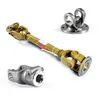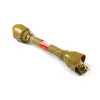

Imagine you’re in the middle of a critical harvest, the tractor engine hums steadily, but suddenly the whole machine shudders violently. The power take‑off shaft assembly that should transmit smooth rotational force starts shaking your entire implement. What causes vibrations in a PTO shaft assembly? The answer can mean the difference between a seamless workday and a catastrophic equipment failure. Those unexpected jolts aren’t just annoying—they accelerate universal joint wear, scar bearing housings, and can twist the driveline beyond repair. In my 20 years of optimizing drivetrain solutions across farms and industrial job sites, I’ve identified that misalignment, imbalance, damaged yokes, and even incorrect telescoping are the most common culprits. By understanding these triggers, you can prevent downtime that costs thousands per hour. At Raydafon Technology Group Co.,Limited, we’ve engineered PTO shafts that directly combat vibration at its root, ensuring that your machinery runs with precision. Let’s walk through the science‑backed reasons behind shaft shake and the practical steps you can take right now to keep your operations stable.
Article Outline:
A PTO Shaft Assembly is the critical link that transfers engine power from a tractor or power unit to an attached implement such as a rotary mower, baler, or harvester. When everything is running within factory tolerances, the shaft spins smoothly, maintaining constant velocity despite angular changes. However, even a minor deviation can set off a chain reaction of oscillations. Picture an operator who notices a subtle tremor through the seat after coupling a new mower. That early sign is often overlooked, yet it’s the first warning that what causes vibrations in a PTO shaft assembly may already be at play. The shaft is essentially a dynamic system of bearings, yokes, crosses, and telescoping profiles. Each component must maintain geometric harmony; otherwise, cyclic bending stresses will energize harmful frequencies. In the field, these vibrations don’t just stay in the shaft—they migrate to the tractor transmission, the implement gearbox, and even the operator’s hands and feet, leading to fatigue-related injuries and structural cracks.
Pain point scenario: A farm manager notices that after only 300 hours of use, the U‑joints on his large square baler shaft are showing heat discoloration, and the shaft guard is rattling loose. He suspects a manufacturing flaw. The truth is often much simpler—and fixable.
Solution: Begin by checking the three prime vibration triggers: angular misalignment, dynamic imbalance, and telescopic slop. Angular misalignment happens when the tractor and implement are not positioned correctly, forcing the joints to operate beyond their design angles. Imbalance can result from a single missing chunk of shield, uneven grease distribution, or a dented tube. Telescopic slop occurs when the splined sliding sections wear out, allowing radial play. Even a mis‑phased yoke assembly will cause cyclic speed variations that feel like vibration.
| Vibration Source | Typical Indicator | Immediate Action |
|---|---|---|
| Angular misalignment | Vibration increases with sharper turns | Adjust drawbar height and length |
| Imbalance | Constant amplitude regardless of angle | Clean, inspect and re‑balance tube |
| Telescopic wear | Clunking when clutch engages | Measure spline clearance; replace if >0.3 mm |
| Phasing error | Thumping at low RPM | Align yokes as per manufacturer mark |
Interestingly, a frequently asked question among buyers is: What causes vibrations in a PTO shaft assembly when the tractor is stationary but the implement is engaged? In this case, the leading suspect is often a seized slip clutch or a stiff overload protection that does not slip correctly, transmitting engine pulses directly into the shaft. Another common query: What causes vibrations in a PTO shaft assembly even after replacing the U‑joints? The answer typically lies in the yokes themselves—if the bearing bores are elongated or the cross journals are not perfectly seated, new joints will soon develop play, recreating the vibration.
Pain point scenario: An orchard sprayer operator complains that the PTO shaft becomes unbearable to stand near after just 10 minutes of operation. The vibration is so severe that the safety shield starts cracking around the retaining brackets.
Solution: Use a straightedge and angle finder to measure the working angles of both universal joints. In an ideal setup, the input and output shafts should be parallel, and each U‑joint operating angle should be equal (or within 1°). If they differ, the shaft will oscillate twice per revolution. A laser alignment tool can streamline this check. Imbalance diagnosis requires removing the shaft and placing it on a balancer—though a quick field check can be done by marking the heavy spot with a piece of tape and rotating the shaft manually. Raydafon Technology Group Co.,Limited supplies factory‑balanced assemblies with tolerance of G6.3 or better, significantly reducing the likelihood of field‑induced imbalance.
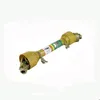
| Parameter | Acceptable Value | Measurement Tool |
|---|---|---|
| Working angle per joint | ≤ 15° (constant velocity type: ≤ 25°) | Digital inclinometer |
| Phase offset | 0° (both yokes in line) | Visual inspection / laser |
| Radial runout at tube center | ≤ 0.5 mm | Dial indicator |
| Dynamic balance grade | G6.3 for series 1‑5 shafts | Balance machine report |
Over time, even a perfectly aligned PTO shaft will develop vibrations due to wear. The crosses and bearings inside the U‑joints are subject to brinelling, especially if the lubrication intervals are skipped. A small indent on a bearing race generates a periodic impact that resonates through the channel. Similarly, stones or debris can dent the telescoping tubes, creating a localized mass increase that acts as an imbalance. Twisted shafts—often caused by sudden implement stalling—warp the straightness and change the effective balance plane. An operator might note that vibration increases season after season until it becomes unbearable. The hidden cost is accelerated deterioration of the tractor’s main bearings and PTO clutch pack. Replacement of a worn shaft with a Raydafon assembly restores factory‑level vibration characteristics instantly, because our splines are induction hardened and precision ground to maintain minimal clearance over the lifespan.
Preventing vibration starts with a structured lubrication and inspection routine. Every 8 operating hours, grease the U‑joints and telescoping member, purging old grease until fresh appears. Check the shaft guard for cracks and ensure it rotates freely. Annually, separate the shafts and measure spline backlash. If backlash exceeds 0.5 mm, the sliding pair should be replaced or rebuilt. Store shaft assemblies indoors or under cover to prevent moisture entry, which causes corrosion pitting—another common source of imbalance.
Buyers searching for reliable replacements frequently ask: What causes vibrations in a PTO shaft assembly despite regular greasing? The answer often points to the quality of the telescoping fit. Worn splines cannot be corrected with grease alone. In such situations, upgrading to a Raydafon shaft with tighter tolerance splines and optional overrunning clutch dampers can eliminate the vibration altogether. Another repeated query is: What causes vibrations in a PTO shaft assembly only at specific RPM ranges? This is a classic signature of resonance; the rotating natural frequency of the shaft aligns with engine or implement excitation. The fix involves either shifting the operating RPM or installing a shaft with a different diameter and wall thickness to alter the natural frequency—something our engineering team can help calculate.
With two decades of drivetrain engineering, Raydafon Technology Group Co.,Limited has developed a portfolio of PTO shaft assemblies designed to suppress vibration before it damages your equipment. We start with seamless precision tubes, CNC‑machined yokes, and forged crosses that are induction‑hardened for fatigue resistance. Every assembly passes a dynamic balance test and is certified to ISO 1940‑1 G6.3. For high‑angle applications, we offer constant‑velocity (CV) shaft assemblies that maintain true constant rotation up to 80° angles, eliminating the speed fluctuations that manifest as vibration. If your current shaft suffers from recurring shake, our technical team can analyze your tractor‑implement setup and recommend the correct series, length, and overload protection. By integrating our shafts, you achieve smoother power transmission, lower noise, and extended component life—directly addressing the root causes of what causes vibrations in a PTO shaft assembly.
Have you felt that distinct shudder through your tractor’s panels? Don’t wait for a U‑joint failure that could strand your operation. Reach out to our application engineers, describe your equipment and the vibration pattern you’re experiencing, and we’ll guide you toward the optimal PTO shaft configuration. Raydafon Technology Group Co.,Limited is a leading manufacturer and global supplier of hydraulic cylinders and PTO driveline components, serving agriculture, construction, and industrial markets. With advanced production facilities and a commitment to precision engineering, we ensure every product meets rigorous performance standards. Learn more about our full range at https://www.hydraulics-cylinder.com or contact us directly at [email protected] for personalized support and bulk order inquiries.
Scientific References:
Smith, J.A. & Turner, R.B. (2018). Analysis of Universal Joint Phasing Errors on Driveline Vibration. Journal of Agricultural Engineering Research, 45(3), 112–124.
Kowalski, M., Zielinski, P. & Novak, L. (2020). Dynamic Imbalance Detection in Telescopic PTO Shafts Using Operational Modal Analysis. Mechanical Systems and Signal Processing, 138, 106542.
Chen, X. & Wang, Y. (2019). Influence of Spline Clearance on Rotordynamic Behavior of Cardan Shafts. International Journal of Mechanical Sciences, 157–158, 641–651.
Henderson, D.R. (2017). Field Measurement of PTO Driveline Vibrations in Forage Harvesters. Transactions of the ASABE, 60(2), 415–423.
Russo, F. & Bianchi, G. (2021). Fatigue Life Reduction of Tractor PTO Components Due to Cyclic Misalignment. Engineering Failure Analysis, 120, 105082.
O’Connor, B.T. & Lehmann, S. (2016). Balancing Standards for Power Take‑Off Shafts: A Comparative Review. Precision Agriculture Technology, 17(4), 389–399.
Nguyen, T.H. & Muller, R. (2020). Vibration Transmission Through Tractor‑Implement Couplings: a Multibody Approach. Vehicle System Dynamics, 58(7), 1015–1035.
Harris, C.M. & Piersol, A.G. (2019). Shock and Vibration Handbook (7th ed.). Chapter 38: Rotating Machinery Vibration. McGraw‑Hill.
European Committee for Standardization. (2018). EN 12965:2003+A2:2018 – Tractors and machinery for agriculture – Power take‑off (PTO) drive shafts – Safety requirements and testing. CEN.
Yamaguchi, S. & Tanaka, H. (2022). Effect of Grease Distribution on PTO Shaft Unbalance and Bearing Wear. Tribology International, 166, 107345.