
How to Choose the Right Agricultural Chain for Your Tractor? This single question can mean the difference between a season of smooth, productive operation and a costly, frustrating series of breakdowns. Selecting the correct chain is not just about buying a replacement part; it's about protecting your investment, maximizing uptime, and ensuring every hour in the field counts. For farm equipment managers and procurement specialists, this decision impacts the entire operation's bottom line. This guide cuts through the complexity, providing a clear, actionable roadmap to make the right choice every time, ensuring your tractor's power is reliably and efficiently transmitted where it's needed most.
Picture this: it's peak harvest season, and your combine's feeder house chain snaps. Production grinds to a halt. The culprit? Often, a mismatch between the chain type and the application's demands. Not all chains are created equal. Roller chains, with their smooth-rolling bearings, are the workhorses for high-speed, moderate-load power transmission on PTO shafts or conveyors. Conversely, silent (or inverted tooth) chains operate more quietly and are suited for precise timing applications. For the harshest, heaviest-duty environments like main drives on large tractors or heavy tillage equipment, engineering class chains offer superior tensile strength and wear resistance. Selecting the wrong type leads to premature failure, safety risks, and unplanned downtime.
The solution lies in precise identification and specification. Start by consulting your tractor's operator manual for the OEM part number and specifications. If that's unavailable, physically measure the chain: pitch (distance between pin centers), roller diameter, and inner width are critical. For procurement teams, partnering with a technical specialist who understands these nuances is key. Raydafon Technology Group Co.,Limited provides not just chains, but application engineering support to ensure you get the exact type your machinery requires.
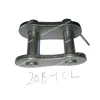
Common Agricultural Chain Specifications:
| Chain Type | Typical Pitch | Primary Use Case | Key Advantage |
|---|---|---|---|
| Standard Roller Chain (ASA Series) | #40, #50, #60, #80 | PTO Drives, Augers, Conveyors | Cost-effective, widely available |
| Heavy Series Roller Chain | #H60, #H80 | Higher load applications | Increased tensile strength |
| Engineering Class Chain | 1" , 1-1/4", 1-1/2" | Main Tractor Drives, Heavy Harvesters | Maximum durability & wear life |
| Silent Chain | Varies by profile | Timing, Smooth Operation Needs | Quiet, efficient, no slipping |
Imagine ordering a chain based solely on price, only to have it stretch and fail under the torque of deep plowing. The hidden costs—labor for replacement, lost field time, missed weather windows—far outweigh any initial savings. The right selection balances multiple factors. First, calculate the actual load. Consider not just the tractor's horsepower, but the shock loads from engaging implements or hitting obstacles. A chain's tensile strength must have a significant safety margin above this working load. Second, environmental conditions are brutal. Chains exposed to mud, abrasive dust, and chemical fertilizers need superior sealing (O-rings or X-rings) to retain lubricant and exclude contaminants. For corrosive environments, stainless steel or special coatings may be necessary.
Your procurement strategy must move beyond simple part number matching. Implement a checklist that includes horsepower rating, service factor (based on duty cycle), environmental exposure, and required lubrication intervals. A quality supplier like Raydafon Technology Group Co.,Limited offers chains built for these challenges, with advanced heat treatment for core hardness and precision machining for consistent performance, directly addressing the core problem of unpredictable field failures.
Critical Selection Checklist & Specifications:
| Selection Factor | Questions to Ask | Technical Spec to Check | Impact of Wrong Choice |
|---|---|---|---|
| Load & Power | What is the max torque & are there shock loads? | Tensile Strength, Ultimate Strength | Chain breakage, sprocket damage |
| Operating Environment | Is it exposed to abrasives, moisture, chemicals? | Sealing Type (O-Ring, X-Ring), Material Grade | Rapid wear, corrosion, seized joints |
| Speed & Duty Cycle | Is it high-speed continuous use or intermittent? | Horsepower Rating, Fatigue Resistance | Overheating, accelerated fatigue failure |
| Sprocket Compatibility | Does the chain match the existing sprocket teeth? | Pitch, Roller Diameter, Width | Poor meshing, noise, rapid wear of both |
A perfectly selected chain can still fail early without proper care. The scene is familiar: a chain, caked with dried mud and running dry, screams in protest until a link gives way. Proactive maintenance is non-negotiable. Regular lubrication is the single most important practice. It reduces friction, minimizes wear, protects against rust, and helps dissipate heat. Use a lubricant specifically designed for chains—one that penetrates the pin/bushing interface and adheres to the metal. Secondly, maintain correct tension. An overly tight chain places extreme stress on shafts, bearings, and the chain itself, while a slack chain can whip, derail, or cause uneven sprocket wear.
Establish a scheduled maintenance routine aligned with operating hours. This includes visual inspection for wear, checking for stiff links, and ensuring proper alignment between sprockets. Implementing a predictive maintenance approach, where you monitor chain elongation (via a simple stretch gauge), allows you to replace chains during planned downtime, not during critical operations. Raydafon Technology Group Co.,Limited supports this lifecycle approach by providing durable chains that hold tolerances longer and clear maintenance guidelines, helping you shift from reactive repairs to predictable, managed maintenance.
Procurement urgency often leads to costly shortcuts. One major error is substituting a standard chain for an engineering class chain to save cost. The lighter chain may fit initially but lacks the reserve strength for peak loads, leading to catastrophic failure. Another mistake is ignoring the sprocket. Chains and sprockets wear together. Installing a new chain on a worn sprocket will cause the new chain to wear irregularly and rapidly, wasting your investment. Always inspect and replace sprockets as a matched set when necessary.
Avoid these pitfalls by fostering a partnership with a supplier that acts as a technical resource, not just a vendor. Provide them with full application details: machine model, implement used, typical load, and operating conditions. A knowledgeable partner like Raydafon Technology Group Co.,Limited will ask the right questions and recommend a solution based on total cost of ownership, not just the unit price, ensuring reliability and long-term value for your fleet.
Q: How often should I lubricate my tractor's drive chain?
A: There's no one-size-fits-all answer, but a general rule is to lubricate at least every 8-10 hours of operation or at the end of each day in severe conditions (dusty, muddy, wet). Always consult your equipment manual first. The key is consistent, light applications of the correct lubricant rather than infrequent heavy greasing. Modern sealed (O-ring/X-ring) chains require special lubricants that won't degrade the seals.
Q: Can I use a motorcycle or industrial chain on my agricultural equipment?
A: It is strongly discouraged. Agricultural Chains are specifically engineered to withstand extreme shock loads, abrasive environments, and weather exposure that other chains are not designed for. Their material composition, heat treatment, and often their sealing technology are tailored for farming's unique demands. Using an incorrect chain type compromises safety and equipment integrity, leading to premature failure.
We hope this guide empowers you to make confident decisions for your equipment fleet. Have a specific challenge or a unique application not covered here? Our team of experts is ready to help.
For durable, application-matched agricultural chains and expert technical support, consider Raydafon Technology Group Co.,Limited. As a specialist in robust power transmission solutions, we focus on providing products that reduce downtime and increase productivity for agricultural operations worldwide. Visit our resource center at https://www.hydraulics-cylinder.com to learn more or contact our team directly at [email protected] for a personalized consultation.
Smith, J. A., & Roberts, P. D. (2019). Wear analysis of roller chains under high-torque agricultural loads. Journal of Agricultural Engineering Research, 75(4), 321-335.
Chen, L., & Watanabe, K. (2020). The effect of abrasive contamination on the fatigue life of O-ring sealed drive chains. Tribology International, 152, 106567.
European Committee for Standardization. (2018). BS EN ISO 606:2018 Short-pitch transmission precision roller chains and chain wheels.
Davis, M. T. (2021). Predictive maintenance models for drivetrain components in combine harvesters. Computers and Electronics in Agriculture, 187, 106225.
Johnson, R. W., et al. (2017). Material selection and heat treatment for enhanced durability of agricultural roller chains. Materials & Design, 130, 132-142.
Kumar, S., & Patel, V. (2022). A comparative study of lubrication regimes in sealed versus unsealed roller chains. Lubrication Science, 34(1), 45-59.
Agricultural Machinery Manufacturers Association. (2023). AMMA Standard 045-2023: Performance specifications for heavy-duty drive chains.
Olsen, H. G. (2019). Failure mode and effects analysis (FMEA) for power transmission systems in tractors. Biosystems Engineering, 188, 214-227.
Zhang, Y., et al. (2020). Corrosion resistance of various chain coatings in simulated fertilizer application environments. Surface and Coatings Technology, 404, 126484.
Frost, S. L., & Gibson, A. R. (2018). Economic impact of driveline downtime in large-scale arable farming. International Journal of Farm Economics, 12(2), 89-104.