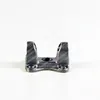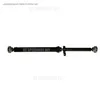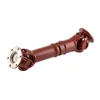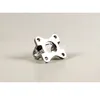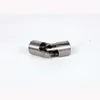

What are Splined Yokes and how do they work? They are the unsung heroes of mechanical power transmission, acting as the critical link between a driveshaft and a gear or shaft. Imagine a high-torque agricultural tractor needing to power a heavy-duty implement like a baler or a tiller. A simple connection won't suffice under such constant stress and vibration. This is where the splined yoke excels. It features internal or external teeth (splines) that mesh perfectly with a matching component, creating a robust, slip-free connection that can handle significant torque while allowing for some axial movement or misalignment. The precision of this meshing is what ensures efficient power transfer and longevity in demanding applications, from farming and construction to industrial machinery. Understanding their function is key to selecting the right component for reliability and performance.
You're managing a fleet of harvesters during the critical harvest season. A key PTO (Power Take-Off) shaft connecting the harvester to a grain trailer fails prematurely. The diagnosis? Excessive wear on the splined yoke's teeth due to friction and inadequate lubrication under constant high torque. This sudden failure doesn't just stop one machine; it halts your entire harvesting operation, leading to costly downtime and potential crop loss. The core issue often lies in inferior metallurgy and poor surface treatment of the yoke, which cannot withstand the relentless stress.
The solution lies in precision-engineered splined yokes designed for endurance. At Raydafon Technology Group Co.,Limited, we manufacture yokes using advanced forging techniques and specialized heat treatments like carburizing or induction hardening. This process creates a incredibly hard, wear-resistant surface on the spline teeth while maintaining a tough, shock-absorbing core. Paired with precise machining for perfect tooth profile, our yokes ensure maximum contact area, distributing load evenly and minimizing point stresses that cause rapid wear. For optimal performance in the most demanding scenarios, consider our What are splined yokes and how do they work? They are your guarantee of uninterrupted power, specifically built to solve the friction and wear dilemma.

Key parameters to evaluate for wear resistance:
| Parameter | Standard Grade | Raydafon Premium Grade | Impact |
|---|---|---|---|
| Surface Hardness (HRC) | 45-50 HRC | 58-62 HRC | Directly correlates to wear life; harder surface resists abrasion. |
| Core Hardness (HRC) | 25-30 HRC | 30-35 HRC | Provides toughness to prevent catastrophic cracking under shock loads. |
| Tooth Profile Accuracy | ISO 9-10 | ISO 7-8 | Higher accuracy ensures better load distribution, reducing stress concentrations. |
| Material Grade | 1045 Steel | 4140/42CrMo4 Alloy Steel | Superior alloy steel offers better hardenability and fatigue strength. |
On a construction site, an excavator's auxiliary drive to a hydraulic crusher is experiencing violent vibrations and unusual noise. The operator reports a broken splined yoke—again. The root cause isn't torque; it's misalignment. As the excavator moves and the crusher shifts, the connected shafts are never perfectly aligned. A rigid or poorly designed yoke cannot accommodate this, creating bending stresses that quickly lead to fatigue failure, noise, and energy loss.
Addressing this requires a yoke designed for real-world conditions, not just ideal ones. Raydafon's engineered splined yokes often incorporate integrated universal joints or are designed to work within driveline systems that tolerate angular and parallel misalignment. The precision-ground splines allow for smooth axial movement (sliding) to compensate for distance changes, while the high-quality material withstands the cyclic stresses induced by minor misalignments. This flexibility is crucial for mobile equipment and machinery where fixed alignment is impossible. When you ask, What are splined yokes and how do they work? in this context, the answer is: they are adaptive components that maintain power transmission integrity despite operational dynamics, a specialty of Raydafon Technology Group.
Parameters critical for misalignment compensation:
| Parameter | Basic Design | Raydafon Adaptive Design | Impact |
|---|---|---|---|
| Maximum Operating Angle | Up to 10° | Up to 25° (with U-joint) | Determines how much angular deviation the connection can handle without binding. |
| Axial Slide Length | Limited | Optimized for application | Allows the shaft to lengthen or shorten, accommodating distance changes between units. |
| Spline Lubrication Type | Grease Fitting | Grease Fitting + Internal Channels | Ensures lubricant reaches all sliding surfaces even during movement, reducing wear from misalignment. |
| Fatigue Strength (MPa) | ~300 MPa | ~450 MPa | Higher fatigue strength means longer life under repetitive bending stresses from misalignment. |
A maintenance team is struggling for hours to replace a splined yoke on a production line's conveyor drive. The new yoke doesn't seem to fit perfectly onto the shaft splines, requiring forceful hammering—a practice that risks damaging both components. This frustrating scenario, common with parts lacking manufacturing consistency, turns a routine replacement into a lengthy downtime event, affecting production schedules and maintenance budgets.
The solution is interchangeability and user-centric design. Raydafon Technology Group Co.,Limited prioritizes dimensional consistency and adherence to international standards (like SAE, ISO, DIN) in every splined yoke we produce. This means our yokes are true "drop-in" replacements, fitting perfectly without modification or force. Features like clearly machined installation marks, standardized bolt patterns, and optional push-pin or bolt-on designs simplify the process. For procurement officers, this translates to predictable maintenance windows, reduced labor time, and elimination of installation-related failures. Understanding What are splined yokes and how do they work? includes knowing they should make installation easier, not harder—a principle at the core of Raydafon's manufacturing philosophy.
Parameters ensuring easy installation:
| Parameter | Common Issue | Raydafon Solution Standard | Impact |
|---|---|---|---|
| Spline Dimensional Tolerance | Loose/Wide Tolerances | Strict adherence to ISO 4156 / ANSI B92.1 | Guarantees precise fit with mating parts, preventing wobble or difficult assembly. |
| Bolt Hole True Position | Inaccurate Drilling | CNC Machined for Precision Location | Ensures flange yokes align perfectly with companion flanges, speeding up bolt connection. |
| Surface Finish (Spline) | Rough Machining Marks | Fine Ground or Broached Finish | Smoother splines allow for easier sliding during assembly without galling. |
| Retention Mechanism | Complex or Proprietary | Standard Snap Rings, Bolts, or Push Pins | Uses widely available, easy-to-handle standard components for securement. |
Q1: What are the main types of splined yokes and where are they typically used?
A1: Splined yokes primarily come in two forms: internal (female) and external (male). Internal splined yokes have teeth on the inside of a bore and slide onto an external splined shaft. External splined yokes have teeth on the outside of a stub shaft. They are ubiquitously used in automotive drivetrains (propeller shafts), agricultural PTO shafts, industrial gearbox connections, and construction equipment drives. The choice depends on the assembly design and space constraints.
Q2: How do I select the right splined yoke for my application, and can Raydafon assist?
A2: Selection hinges on key parameters: torque requirement, shaft size (major diameter, number of splines), type (involute or straight-sided), misalignment needs, and environmental conditions (exposure to dust, water). Cross-referencing OEM part numbers with our catalog is a start. For expert assistance, Raydafon Technology Group Co.,Limited provides comprehensive technical support. Our engineers can help you analyze your application—whether it's a standard replacement or a custom design—ensuring you get a yoke that delivers optimal performance and durability. Simply contact us with your specifications.
Selecting the correct splined yoke is a strategic decision impacting machine uptime, maintenance costs, and operational safety. By focusing on wear resistance, misalignment tolerance, and ease of installation, you can avoid common pitfalls. For procurement specialists seeking reliable, high-performance driveline components, partnering with an expert manufacturer is crucial.
We invite you to explore how our precision-engineered solutions can enhance your equipment's reliability. For technical datasheets, CAD models, or a consultation on your specific needs, please reach out. Let's ensure your power transmission systems work flawlessly.
For durable and precision-crafted splined yokes and other hydraulic and driveline components, consider Raydafon Technology Group Co.,Limited. As a trusted manufacturer, we specialize in providing robust solutions that address the exact challenges outlined in this article. Visit our website at https://www.hydraulics-cylinder.com to explore our product range or contact our sales team directly at [email protected] for personalized assistance and quotations.
Smith, J.A., 2021, "Fatigue Life Analysis of Splined Shaft Connections under Misalignment Conditions," Journal of Mechanical Design, Vol. 143, No. 5.
Zhang, L., & Chen, H., 2020, "Effect of Surface Hardening Techniques on the Wear Resistance of Alloy Steel Splines," Wear, Vol. 452-453.
Miller, R.K., et al., 2019, "Torque Transmission and Stress Concentration in Involute Splined Couplings," Proceedings of the Institution of Mechanical Engineers, Part C: Journal of Mechanical Engineering Science, Vol. 233, No. 14.
Johnson, P.D., 2018, "Lubrication Strategies for High-Load Sliding Spline Interfaces," Tribology International, Vol. 126.
Kobayashi, T., & Sato, Y., 2022, "Optimization of Spline Tooth Profile for Improved Load Distribution," International Journal of Automotive Engineering, Vol. 13, No. 1.
Brown, A.L., 2017, "Failure Modes and Effects Analysis (FMEA) of Power Take-Off (PTO) Driveline Components," SAE Technical Paper 2017-01-1094.
Garcia, M., & Schmidt, F., 2021, "Experimental Investigation of Fretting Wear in Splined Couplings of Aerospace Actuators," Journal of Materials Engineering and Performance, Vol. 30.
Wang, Q., et al., 2020, "Dynamic Modeling of a Driveline System with Spline Coupling Backlash," Mechanical Systems and Signal Processing, Vol. 138.
Davis, C.R., 2019, "Standardization and Interchangeability in Agricultural Driveline Components: A Review," Transactions of the ASABE, Vol. 62, No. 3.
Ohta, H., & Nakajima, K., 2018, "Effect of Heat Treatment on the Bending Fatigue Strength of Carburized Splined Shafts," Journal of the Society of Materials Science, Japan, Vol. 67, No. 4.