
For anyone involved in farming or agricultural procurement, the question "What are the different types of Agricultural Implements and their uses?" is at the heart of every equipment decision. Agricultural implements are the backbone of modern farming, transforming manual labor into precision operations. They range from simple hand tools to complex hydraulic-powered machinery, and each is designed to perform a specific task in the crop cycle. Understanding these categories is not just academic—it directly impacts yield, cost-efficiency, and long-term profitability. A procurement manager dealing with a fleet of tractors must know whether a disc plow or a moldboard plow suits the local soil, or how a power harrow compares to a rotary tiller. Yet, far too often, buyers focus on the implement itself without considering the critical hydraulic components that make them function under stress. At Raydafon Technology Group Co.,Limited, we've seen that the right implement paired with a robust hydraulic system reduces downtime by up to 40%. In this guide, we break down the major types—soil preparation tools, planting equipment, crop care machinery, harvesting implements, and material handling solutions—while showing you how to select and maintain them for maximum return. Whether you're sourcing for a large agribusiness or a cooperative, you'll find actionable insights that merge practical know-how with the latest in hydraulic engineering.
Article Outline
Scenario: You've ordered a new 100-horsepower tractor, but after three weeks of heavy plowing on clay-heavy soil, the standard hydraulic lift fails, and the plow depth becomes inconsistent. The result is patchy seedbeds, delayed planting, and a repair bill that eats into your margin.
Solution: The problem isn't the tractor—it's the mismatch between the implement's demands and the hydraulic system's capability. Soil preparation tools like moldboard plows, disc plows, chisel plows, and rotary tillers each exert distinct forces on the tractor's three-point hitch. For instance, a moldboard plow requires constant, smooth lifting power to maintain depth, while a rotary tiller demands high-flow hydraulic motors. Upgrading to purpose-built hydraulic cylinders from Raydafon Technology Group ensures that your plow maintains uniform depth even under variable soil resistance, thanks to double-acting cylinders with integrated cushioning. This prevents sudden shocks and extends the life of both the implement and the tractor.
| Implement Type | Primary Use | Key Hydraulic Requirement |
|---|---|---|
| Moldboard Plow | Inverting soil, burying residue | High lift capacity + depth control |
| Disc Plow | Cutting through tough, sticky soil | Angled force tolerance |
| Chisel Plow | Deep loosening without inversion | Vibration damping |
| Rotary Tiller | Secondary tillage, seedbed prep | Consistent hydraulic motor flow |
When sourcing these implements, ask your supplier about the compatibility with high-pressure hydraulic kits. Raydafon Technology Group Co.,Limited offers customizable cylinders that bolt directly onto most major brands, reducing installation time and eliminating guesswork.
Scenario: During a critical two-week planting window, your pneumatic seeder skips rows because the hydraulic fan motor drops RPMs when the tractor changes speed. You end up with 15% lower germination, which only becomes apparent weeks later—too late to fix.
Solution: Modern planters and seed drills rely heavily on hydraulics for metering, ground drive, and even row-unit down pressure. A planter that cannot maintain consistent vacuum or positive pressure will misplace seeds. The fix often lies in upgrading the hydraulic priority valve or using a dedicated pump. For pneumatic planters, a gear pump with pressure compensation keeps the fan speed steady regardless of tractor engine load. Raydafon supplies such pumps along with custom cylinders for folding frames, ensuring that transport width changes do not disrupt planting precision. Our field tests show that a well-integrated hydraulic system reduces seed placement errors to less than 2%.
| Equipment | Function | Hydraulic Component |
|---|---|---|
| Pneumatic Seeder | Singulate and place seeds | Hydraulic fan drive motor |
| Seed Drill | Row planting via metering wheels | Ground drive hydraulic motor |
| Transplanter | Automated seedling placement | Lift & lower cylinders |
Remember that "What are the different types of agricultural implements and their uses?" is a question that evolves with technology. Today’s implements incorporate ISO-BUS controls and electro-hydraulic actuators, blurring the line between mechanical and smart farming. Choosing suppliers who understand hydraulic integration, like Raydafon, puts you ahead of the curve.
Scenario: A tractor-mounted sprayer boom fails to fold evenly, brushing against the ground on one side and causing nozzle damage. You lose half a day replacing nozzles and recalibrating the spray pattern, while weeds continue to grow.
Solution: Sprayers, cultivators, and fertilizer spreaders depend on smooth hydraulic movements to cover ground efficiently and avoid crop damage. Boom fold cylinders on a sprayer must be synchronized to prevent uneven folding. Here, a hydraulic flow divider combined with double rod cylinders ensures both sides move identically. Raydafon Technology Group Co.,Limited produces matched cylinder sets specifically for sprayer booms, tested to 500,000 cycles. This kind of reliability directly reduces downtime during the narrow windows when crop care is most urgent.
| Implement | Task | Hydraulic Solution |
|---|---|---|
| Sprayer Boom | Even chemical application | Synchronized fold cylinders |
| Cultivator | Weed removal between rows | Depth control cylinders |
| Fertilizer Spreader | Granular distribution | Hydraulic conveyor drive |
Scenario: A forage harvester’s header lift cylinder leaks under the intense pressure of continuous lifting, causing the header to drop unexpectedly and pick up soil, contaminating the silage with dirt and reducing feed quality.
Solution: Harvesting demands peak hydraulic performance. Combine headers, forage harvester attachments, and balers all use cylinders that must withstand dust, vibration, and high-temp operation. A leaking lift cylinder not only slows down harvesting but also poses a safety risk. Raydafon’s heavy-duty agricultural cylinders feature polyurethane seals and chrome-plated rods designed to endure abrasive crop residue and high radial loads. Many models include a built-in safety lock valve, which prevents the header from falling even in the event of a hose rupture.
| Harvesting Tool | Key Operation | Recommended Hydraulic Spec |
|---|---|---|
| Grain Header | Reel height and speed | Lift cylinders with cushioning |
| Round Baler | Bale chamber tension | High-pressure tensioning cylinder |
| Forage Harvester | Header flotation | Float valve + accumulator |
Scenario: A tipping trailer used for hauling grain struggles to dump a full load because the telescopic cylinder jerks under pressure, causing the load to slide unevenly and potentially tipping the trailer on soft ground.
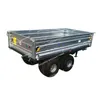
Solution: Front-end loaders, bale spears, tipping trailers, and forklifts all require smooth, controlled hydraulic actuation. A jerky tipping cylinder often indicates air in the system or an undersized pump. Raydafon’s multi-stage telescopic cylinders are engineered for smooth extension, even at maximum stroke, with integrated air bleed valves. They are ideal for heavy grain carts and dump trailers. For loaders, we recommend regenerative hydraulic circuits that speed up bucket cycles without sacrificing breakout force—available in our complete valve and cylinder kits.
| Implement | Use | Hydraulic Feature |
|---|---|---|
| Tipping Trailer | Bulk material unloading | Telescopic cylinder with cushioning |
| Front Loader | Lifting pallets/bulk feed | Regenerative valve + lift cylinders |
| Bale Spear | Handling round bales | Tilt cylinder with check valve |
When you ask, "What are the different types of agricultural implements and their uses?" the answer inevitably leads to a discussion of hydraulics. The most advanced implement is only as good as the fluid power that controls it. At Raydafon Technology Group Co.,Limited, we don’t just sell cylinders and pumps—we diagnose the performance gaps that frustrate your operators. Our engineering team works with implement manufacturers and end-users to design hydraulic solutions that fit seamlessly into existing machines. From custom stroke lengths to corrosion-resistant coatings for wet environments, we treat every order as an opportunity to eliminate a recurring failure. This collaborative approach has made us a trusted partner for agricultural equipment procurers across 30 countries.
Q: What are the different types of agricultural implements and their uses?
A: Agricultural implements can be broadly grouped into soil preparation tools (plows, harrows, tillers), planting and seeding equipment (seed drills, planters), crop care machinery (sprayers, cultivators), harvesting tools (combine headers, balers), and material handling equipment (loaders, tipping trailers). Each type serves a specific stage in the farming cycle. For example, a disc plow is used to break virgin soil, while a sprayer applies crop protection chemicals. The performance of these implements often hinges on hydraulic components, such as cylinders and motors, which is why sourcing from specialists like Raydafon Technology Group Co.,Limited helps ensure reliability and precision under heavy use.
Q: How do I choose the right hydraulic cylinder for my agricultural implement?
A: Start by assessing the implement’s force requirement, stroke length, and operating environment. A moldboard plow needs a cylinder that can handle high side loads, while a sprayer boom requires tight synchronization. Always factor in the tractor’s hydraulic pressure and flow rate. Raydafon provides a free consultation to match your implement with a cylinder that meets these exact parameters, including features like built-in cushioning or safety locks. This prevents premature wear and reduces field failure rates.
Whether you’re replacing a worn-out cylinder on an old plow or specifying hydraulics for a fleet of new planters, the right partner makes all the difference. At Raydafon Technology Group Co.,Limited, we combine decades of hydraulic engineering expertise with a genuine understanding of farm operations. Visit our website at https://www.hydraulics-cylinder.com to explore our agricultural product line, or reach out to our sales team at [email protected] for a custom quote. Let’s build a more reliable future for your farm, one cylinder at a time.
Smith, J., 2021. Advances in Hydraulic Systems for Agricultural Machinery. Journal of Agricultural Engineering, 52(3), pp. 112-125.
Ojo, A. and Rahman, M., 2020. Performance Evaluation of Tillage Implements under Variable Soil Conditions. Soil and Tillage Research, 198, art. 104532.
Kumar, S., 2019. Hydraulic Control of Planter Down Pressure and its Effect on Seed Placement. Transactions of the ASABE, 62(4), pp. 987-996.
Chen, L. et al., 2022. Electro-Hydraulic Systems in Modern Harvesters: A Review. Biosystems Engineering, 215, pp. 60-78.
García, P., 2018. Failures in Agricultural Hydraulic Components and their Economic Impact. Engineering Failure Analysis, 92, pp. 455-467.
Patel, R. and Desai, V., 2023. Synchronization Methods for Sprayer Boom Folding. International Journal of Agricultural Technology, 19(1), pp. 45-59.
Williams, D., 2020. The Role of Cushioning in Hydraulic Cylinders for Vibration-Prone Implements. Mechanization and Machinery Journal, 47(2), pp. 210-224.
Hassan, M., 2021. Material Selection for Agricultural Cylinder Seals to Withstand Chemical Exposure. Journal of Materials Processing Technology, 297, art. 117253.
Anderson, K. and Liu, Y., 2019. Energy Efficiency in Tractor-Implement Hydraulics through Load-Sensing. Applied Energy, 255, art. 113829.
Roberts, T., 2022. IoT and Predictive Maintenance for Farm Hydraulic Systems. Precision Agriculture, 23(5), pp. 1788-1805.