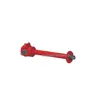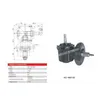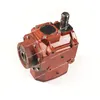


A tractor PTO gearbox for rotary mowers, rotary cutters and slashers, rated at 540 rpm input and up to 60 HP, produced for the European market and held in stock for immediate supply. The gearbox is customised to the implement rather than supplied as a universal unit: the housing, shaft arrangement, ratio and mounting are matched to the mower deck, and the gear material and hardening specification are set to the duty.
A rotary mower gearbox takes the 540 rpm output of a tractor PTO and turns it through 90 degrees to drive the mower blade carrier. That is the whole function, and it is why the gearbox is the component that determines whether the mower can be run at full power: the input speed is fixed by the tractor, so the gearbox ratio sets the blade tip speed, and its torque capacity sets the heaviest growth the machine can cut without stalling or breaking something.
A 540 rpm input at 60 HP represents about 45 kW, which at that input speed is roughly 790 N·m at the input shaft. That torque is substantial, and because the mower blade carrier has high inertia, the gearbox sees not just steady torque but the shock of every impact with a stone, a stump or a fence post. That is why a mower gearbox is specified on both its continuous rating and its ability to absorb shock, and why two gearboxes of similar nominal power can behave very differently in service.
The rotary cutter gearbox range covers the usual configurations used on mower decks: the standard right-angle unit with a single output shaft for a single-spindle mower, and units arranged for multi-spindle decks. Whether the machine is cutting brush or mowing pasture, the correct gearbox is determined by the blade carrier it has to drive and the tractor power behind it, not by a generic category. Related agricultural drive components are covered under the agricultural gearbox range and the PTO drive shaft and parts range, since the gearbox is normally supplied together with the PTO shaft and the implement's driveline.

The table below sets out the confirmed supply information for this gearbox. Where a value depends on the implement it is built for, it is produced to your drawing rather than fixed at a nominal figure.
Specification table — on a mobile device, scroll sideways to read every column.
| Item | Specification |
|---|---|
| Product type | Tractor PTO gearbox for rotary mowers, rotary cutters and slashers |
| Input speed | 540 rpm |
| Power rating | Up to 60 HP (45 kW) |
| Input torque at rated power | Approx. 790 N·m at 540 rpm |
| Drive configuration | Right-angle drive from the PTO input to the blade carrier output |
| Gear ratio | Matched to the blade carrier diameter and required blade tip speed, and confirmed against your implement |
| Output shaft | Diameter, length and key or spline arrangement produced to your implement drawing |
| Input shaft | PTO spline matched to the tractor; 1-3/8 inch 6-spline is the standard connection for 540 rpm |
| Mounting | Produced to your deck fixing hole centres and spigot diameter |
| Housing material | Cast iron housing; gear materials to customer requirement |
| Lubrication | Oil grade and fill quantity supplied with the gearbox |
| Weight | Depends on shaft and mounting configuration; stated on the quotation |
| Market specification | Customised for the European tractor market |
| Availability | In stock for immediate supply |
The material and heat treatment of the gear set are specified to the duty rather than taken from standard stock. The options available across the agricultural gearbox range are listed below.
| Materials available | Low carbon steel, C45, 20CrMnTi, 42CrMo, 40Cr and stainless steel. The material is selected against the duty and adapted to customer requirements — a light-duty finish mower gearbox and a heavy brush cutter gearbox will not use the same gear steel. |
| Heat treatment | High frequency (induction) quenching, hardened teeth, carburising and nitriding. Induction quenching hardens the tooth flanks while leaving the core tough, which is the usual treatment for mower gear sets because it resists both wear and shock. Carburising and nitriding are used where a deeper or more uniform case is required. |
| Surface treatment | Blacking, galvanising, chroming, electrophoresis and colour painting. Surface treatment is chosen for corrosion resistance rather than appearance: a mower gearbox works in grass, moisture and soil, and the exterior finish is what protects the housing when the paint film is chipped by stones. |
| Why treatment choice matters | On a mower gearbox the failure that ends service life is normally tooth wear or tooth breakage, not housing corrosion. That makes the gear steel and the heat treatment the two decisions that determine life, and the surface treatment a secondary decision. When specifying, state the duty — brush, heavy grass or pasture finish mowing — so the gear set can be matched rather than defaulted. |

A mower gearbox is a drop-in component: it bolts to the deck and the blade carrier bolts to its output shaft. Two things therefore have to be right before it can be fitted, and both are decided at the specification stage rather than on the machine.
| Mounting face and hole centres | The gearbox flange bolts to the mower deck through a fixed hole pattern. Measure the hole centres, the spigot or register diameter and the flange thickness from the deck, or from the gearbox being replaced, and confirm them against the drawing. A gearbox with the correct ratio but the wrong flange pattern cannot be fitted without an adaptor plate, which changes the output shaft height and can put the blade carrier at the wrong height above the deck. |
| Output shaft height and length | The blade carrier sits at a specific height under the deck, and that height is set by the gearbox output shaft length combined with the flange thickness. If the replacement gearbox output is shorter or longer than the original, the blade height changes and so does the cut. Confirm shaft length and the position of the key or spline relative to the flange face. |
| PTO shaft alignment | The PTO shaft from the tractor must meet the gearbox input without exceeding the maximum operating angle of its universal joints, and the shaft must have enough telescopic travel to cover the full lift range of the three-point linkage. Check both at the lowest and highest positions of the mower. |
| Blade carrier balance | Fit the blade carrier and blades as an assembly and check balance before running. An unbalanced carrier loads the gearbox output bearing and shows up as vibration and gear noise long before it shows as a bearing failure. |
| Shear bolt or slip clutch | Confirm whether the driveline is protected by a shear bolt or a slip clutch, and set it correctly. The gearbox is rated to 60 HP in normal duty; a blade strike with a stump can momentarily exceed that many times over, and the protection device is what saves the gearbox. A seized slip clutch or an oversized shear bolt converts a cheap driveline part into a gearbox replacement. |
| First run and oil check | Run the mower at low engine speed for a short period, then check the gearbox oil level and look for leakage at the shafts and the flange joint. Re-check the mounting bolts after the first working session, because vibration loosens deck fixings. |
The protection device is part of the gearbox specification. A mower gearbox rated at 60 HP is not designed to survive a direct blade strike — nothing in this size class is. The shear bolt or slip clutch is what absorbs that event, and it only works if it is set correctly and checked regularly.
The gearbox is used on tractor-mounted and trailed mowing equipment across the European market, and on the implement types below.
| Rotary cutters and slashers | Single and multi-spindle cutters for rough grass, scrub and light brush, where shock loading from blade strikes is the dominant design case. |
| Finish mowers | Deck mowers used for pasture and amenity grass, where a consistent blade tip speed matters more than shock capacity because the cut quality depends on it. |
| Flail mowers | Mowers using a flail rotor rather than a blade carrier, where the gearbox drives a heavier rotating mass and belt or direct drive arrangements are both used. |
| Rotary tillers | Gearboxes driving a tine rotor in soil, where the torque demand is higher and the shock loading comes from stones rather than grass. |
| Verge and hedge equipment | Mowers working on roadside verges and field margins, where the gearbox is exposed to debris thrown by the blades and the surface treatment has to resist chipping. |
| Replacement and repair | Direct replacement of a failed gearbox on an existing mower, where mounting pattern and output shaft dimensions matter more than the nominal power rating. |
The gearbox is normally supplied as part of a complete implement driveline. Where a mower is being built or rebuilt, the matching components are covered under universal joints for the PTO shaft, agricultural parts for blades and chains, and agricultural implements for the wider machine range.
The gearbox is produced in the manufacturer's own workshop, and the material and heat treatment of the gear set are specified to the duty rather than taken from standard stock. Heat treatment options include high frequency induction quenching, hardened teeth, carburising and nitriding; surface treatment options include blacking, galvanising, chroming, electrophoresis and colour painting. Building to a drawing rather than to a catalogue size is what allows the ratio, the shaft arrangement and the deck mounting to be matched to a specific mower.


Send the gear ratio or blade carrier diameter, the deck mounting hole centres, the output shaft dimensions, the input shaft specification and the tractor power — or simply the model of the gearbox being replaced. We will confirm the configuration and reply with price and availability.
Request a QuotationAddress
Luotuo Industrial Area, Zhenhai District, Ningbo City, China